 SwipeHarbor
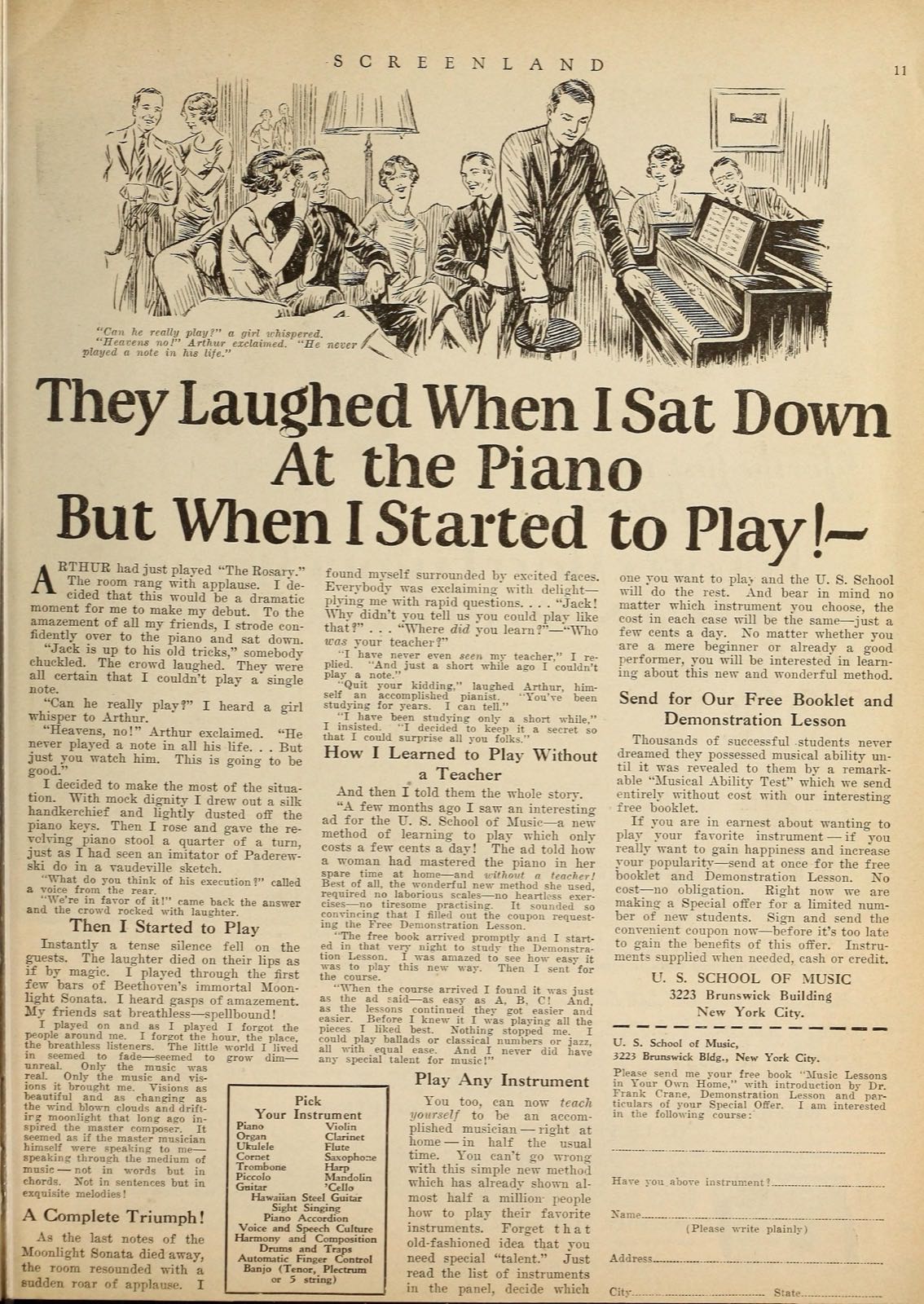
Almost every copywriting list includes this ad, and most of them show a retyped version. We went back to a scan of the page as it ran in Screenland in April 1926. It holds up. The headline stops in mid-sentence, the first few hundred words never mention the product, and the only thing it asks you to do is mail a coupon for something free. Below is the page in five pieces, what each piece does, and a fill-in template so you can try the structure on your own offer.
The page, in five pieces
This is a full-page ad for the U.S. School of Music, a New York correspondence school that sold music lessons by mail. It sits on page 11 of the April 1926 issue of Screenland, a film magazine. The cards above are crops from the Internet Archive’s scan of that page. Open the scan to read it at full size.
John Caples wrote it as a young copywriter at the Ruthrauff & Ryan agency. Sources put the date in 1925 or 1926; the ad itself carries no byline.
Sources: Screenland, April 1926, page 11 (Internet Archive scan) · John Caples (Wikipedia)
The doubters come first
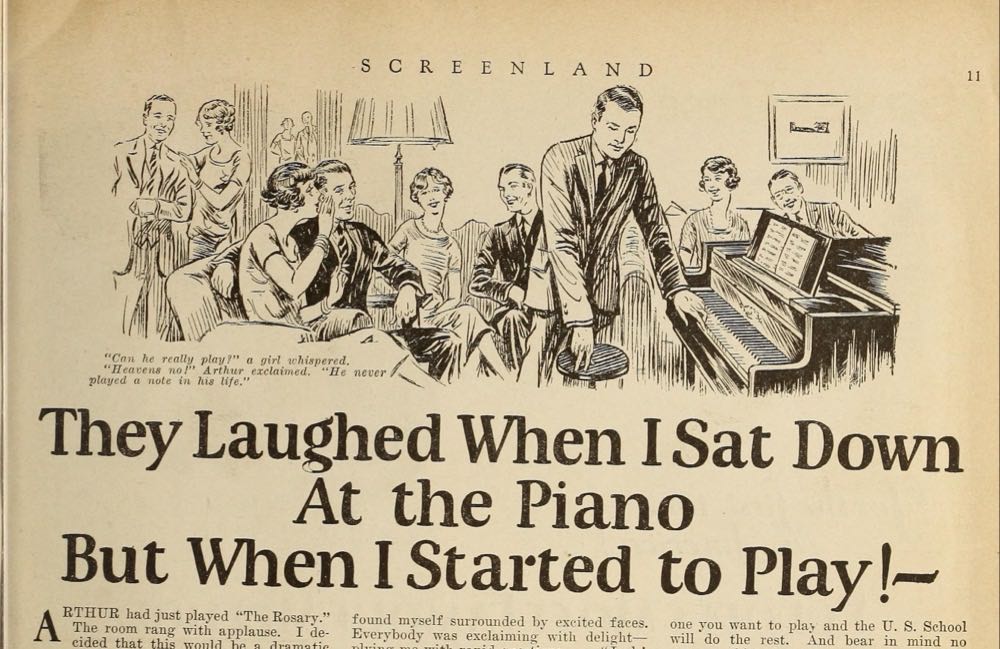
He never played a note in his life.
The headline stops halfway
The full headline is “They Laughed When I Sat Down At the Piano But When I Started to Play!—” It ends on a dash. The reader knows how the story ends, more or less, but has to read on to see it happen.
Look at what the headline is about. It isn’t about pianos or lessons. It’s about being laughed at in a room full of friends, and then turning that around. The drawing above it makes the same point: guests leaning in to whisper while a young man pulls out the piano stool.
That is the part worth borrowing. The headline names a social moment the reader can picture, and it sets up a before and an after in one line.
A scene, not a pitch
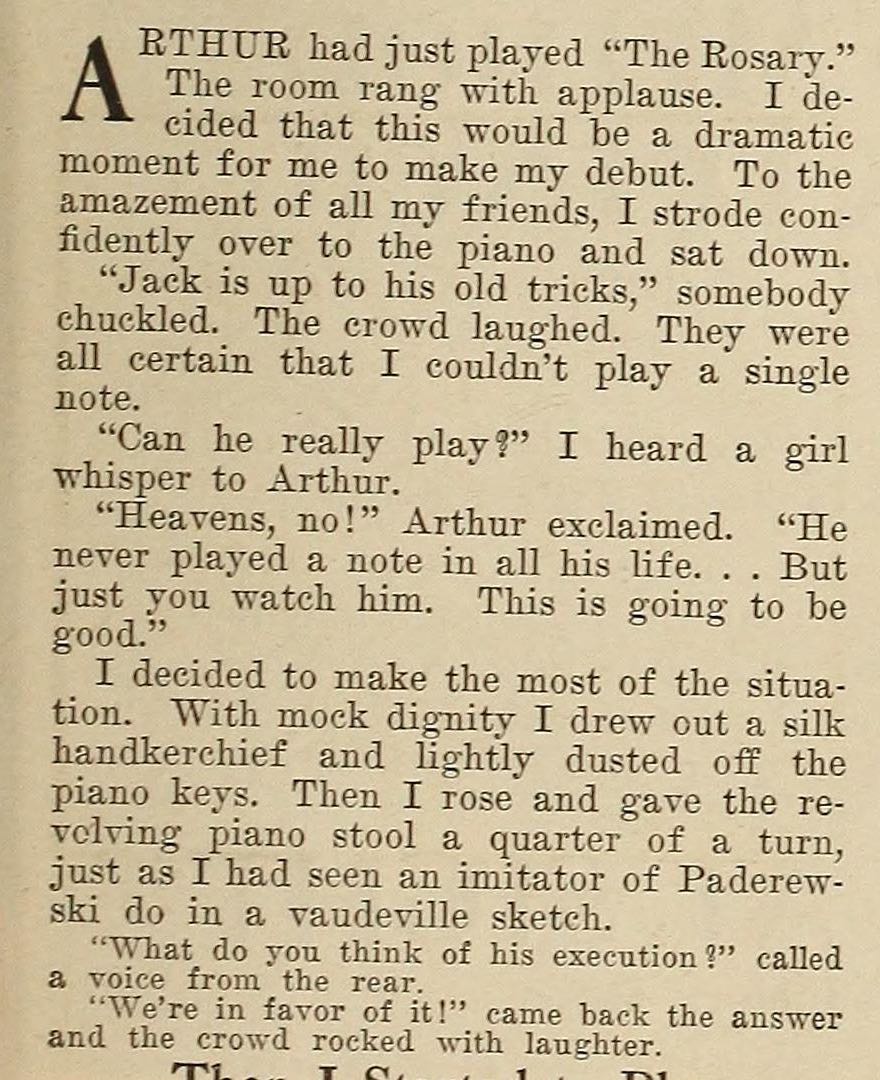
The crowd laughed. They were all certain that I couldn’t play a single note.
The lead is a scene, not a pitch
The copy opens with “Arthur had just played ‘The Rosary.’ The room rang with applause.” Then comes the handkerchief, the joke about his “execution”, and the room going quiet when he plays the Moonlight Sonata.
The school isn’t named until the middle column, close to 400 words in. By then the reader has watched the payoff the headline promised. The sales part arrives as the answer to a question the guests ask: “Where did you learn?”
A modern reader may find the middle section overwritten (“Not in sentences but in exquisite melodies!”). Keep the structure and leave the purple prose.
The story explains itself
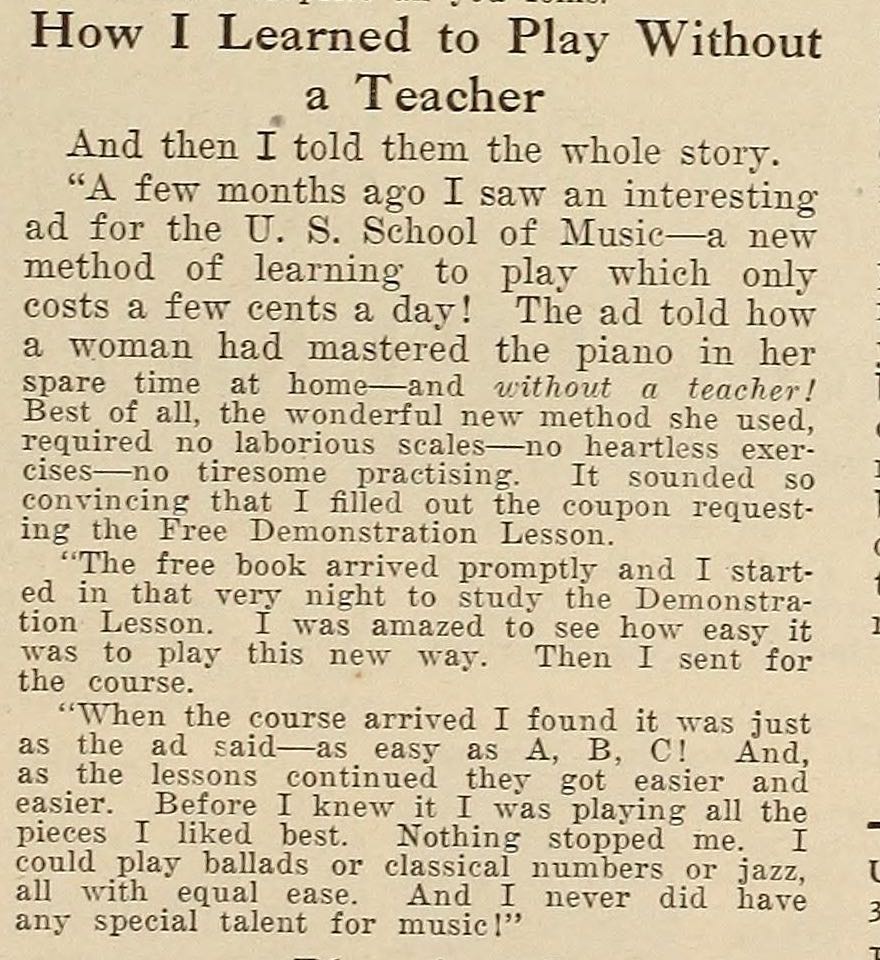
And I never did have any special talent for music!
The proof is a story inside the story
Jack doesn’t claim the course works. His friends react, and Arthur, “himself an accomplished pianist”, refuses to believe he has only studied a short while. The proof comes from the skeptic.
Then the ad nests a second story: Jack says he first saw “an interesting ad for the U. S. School of Music” that told how “a woman had mastered the piano in her spare time at home—and without a teacher!” The ad is a testimonial about reading an ad.
Two things on the page are claims we can’t check. The ad says the method “has already shown almost half a million people how to play their favorite instruments.” It never says whether Jack is a real student. Read both as the advertiser’s words, not as facts.
Six doubts answered before the coupon
Before the ad asks for anything, it deals with six reasons a reader might not reply. Each answer is a phrase, not a paragraph:
- No talent: “Forget that old-fashioned idea that you need special ‘talent.’”
- No teacher, no time: “You too, can now teach yourself to be an accomplished musician—right at home—in half the usual time.”
- Practice is boring: “no laborious scales—no heartless exercises—no tiresome practising.”
- It costs too much: “just a few cents a day.”
- I don’t own an instrument: “Instruments supplied when needed, cash or credit.”
- It’s a risk: “No cost—no obligation.”
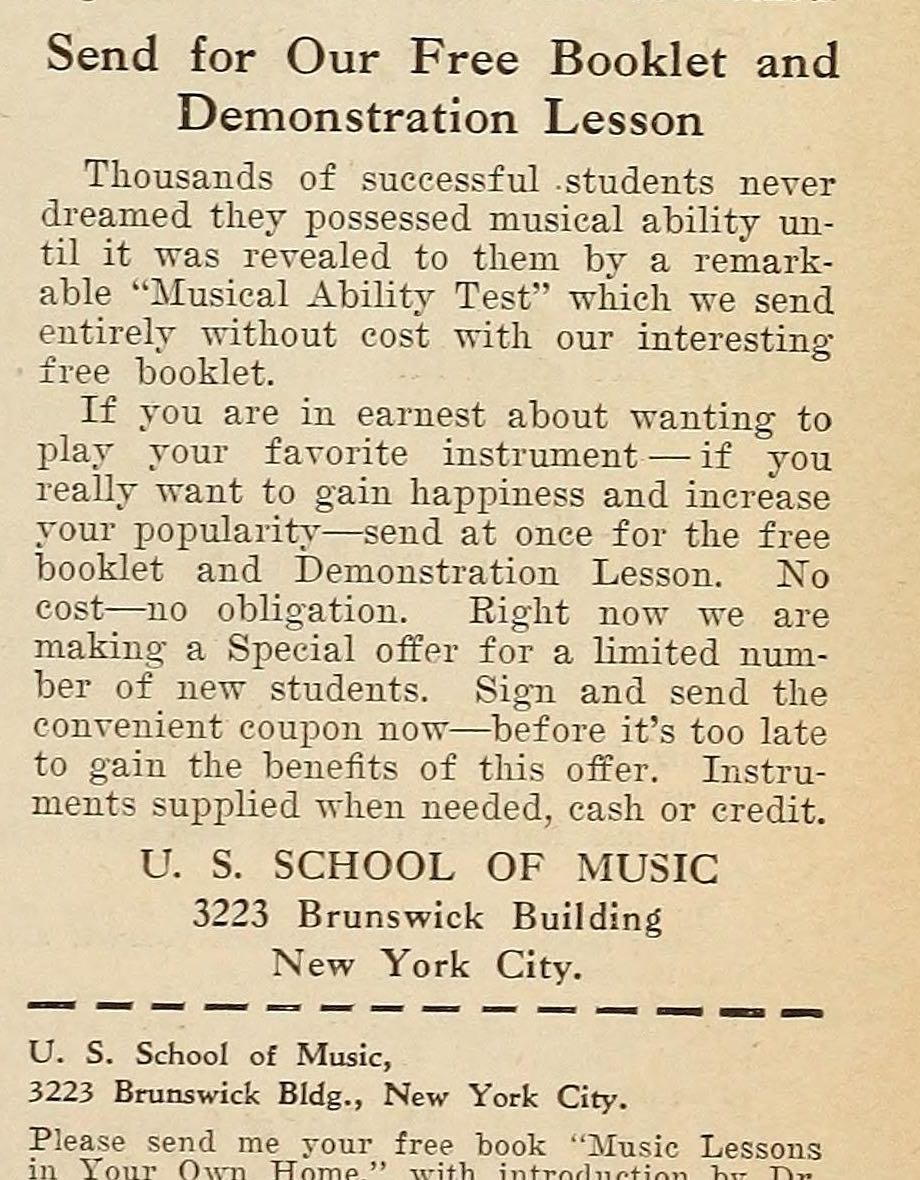
A free first step
No cost—no obligation.
The offer asks for a small yes
The ad never prices the course in dollars. What it offers is a free booklet, “Music Lessons in Your Own Home”, a Demonstration Lesson, and a “Musical Ability Test” sent “entirely without cost”.
So the reader isn’t asked to buy music lessons from a magazine page. They are asked to mail a form for something free. The sale happens later, by mail, after the lesson arrives.
There is a push to act now: “Right now we are making a Special offer for a limited number of new students.” The page doesn’t say what the special offer is. The coupon asks for “particulars of your Special Offer”.
The coupon does the closing
The coupon repeats the offer, asks which course you want, asks “Have you above instrument?”, and gives lines for name, address, city and state. That one question about the instrument tells the school who might also need to buy one.
The coupon address changes from magazine to magazine. The building is the same; the number is not:
- Screenland, April 1926: 3223 Brunswick Building
- The Sunday School Times, October 9, 1926: 3810 Brunswick Bldg.
- Judge, November 12, 1927: 211 Brunswick Bldg.
Sources: Screenland, April 1926 · The Sunday School Times, October 9, 1926 · Judge, November 12, 1927
Why the numbers change
Mail-order advertisers of the period often put a different room or department number in each publication, so a reply showed which magazine it came from. We can’t see the school’s records, so read that as the likely reason, not a proven one.
The runs themselves are on the record: the same headline and story appear in Screenland in April 1926, in The Sunday School Times in October 1926, and in Judge in November 1927. That shows the ad kept running. It does not tell us how many people replied or how many courses were sold.
Map it onto a modern ad and landing page
The 1926 page did the job that an ad and a landing page split today. Here is where each piece goes:
- Headline → the ad’s first line or on-image text. Name a moment the buyer can picture, with a before and an after.
- Drawing → the thumbnail or the first frame of a video. Show the doubt, not the product.
- Story lead → the top of the landing page. Let the reader see the result before you explain the method.
- Proof from a skeptic → a real customer quote, or a reaction from someone who doubted.
- Six doubts → a short answers block above the button, one line each.
- Free first step → a sample, quiz, demo or trial that costs nothing to try.
- Coupon → a short form. Ask only what you need for the next step, plus one qualifying question.
- Changing address numbers → UTM tags or a different code for each placement.
A fill-in template
This is our template, built from the structure above. Fill in the brackets with your own product and your own facts.
- Headline: [People who knew me] [doubted / laughed / looked away] when I [visible attempt]. But when I [the result they could see]—
- Opening scene, 3 to 5 sentences: where it happened, who was there, the moment the doubt was spoken out loud.
- The turn: one line where the result shows. No product name yet.
- The question: someone asks how. Answer with the product name and one sentence on what it is.
- Proof: one detail from a real customer, or a reaction from someone who expected the opposite.
- Doubts: list the four to six reasons a reader would not act, with a one-line answer to each.
- First step: a free or low-risk action, with what the reader gets and when.
- Form: the fields you need, plus one question that tells you how to follow up.
Try it in 20 minutes
You will finish with three headlines, a doubts list and a first step. That is enough for one ad and the top of one landing page.
When you are done, compare your draft with the health ad hooks we checked on NewsBreak to see how today’s advertisers open their stories.
- Pick one product you sell or are writing for.
- Write down the moment a customer was doubted, before they used it. If you don’t have a real one, ask a customer or check your reviews. Don’t invent one.
- Fill in the headline line from the template three different ways.
- Write the six doubts a buyer has about your product, and one honest line for each.
- Choose the free first step. If you can’t offer one, write down why.
- Read the draft out loud. Cut any sentence that praises the product before the result has been shown.
- Save it as a test brief: one headline to test, the placement, and how you will judge it.
Sources: Ad creative brief template · NewsBreak health ads: image text vs headline
What we can’t tell you
We have no sales or response numbers for this ad. Its fame and the fact that it kept running are not results, and this guide does not claim any.
The authorship and date come from secondary sources. The page itself has no byline, and sources give 1925 or 1926.
A first-person story in a modern ad has rules the 1926 page was not written to meet. The FTC says an endorsement must reflect the honest opinion of the endorser, and an ad that shows unusual results must make clear what people can generally expect. Use a real customer’s story, or write the copy so it is plainly yours.
The page images are our crops of the Internet Archive scan. The ad was published in the United States in 1926, and U.S. works published that year entered the public domain on January 1, 2022. Later books that reprint or discuss the ad are separate works with their own copyright; we only link to them.
Sources: Screenland, April 1926, page 11 (Internet Archive scan) · Duke Center for the Study of the Public Domain: Public Domain Day 2022 · FTC: Endorsement Guides, What People Are Asking